
SOTHEBY’S INTERNATIONAL REALTY RELEASES 2026 LUXURY OUTLOOK REPORT, SHOWS LUXURY RESIDENCES LEADING THE YEAR’S REAL ESTATE MARKET

Sotheby’s International Realty released its 2026 Luxury Outlook® report, analyzing the evolving state of global luxury real estate markets and the economic policies and factors that influence them most. The latest edition offers insights into the trends and developments shaping the sector. After outperforming traditional real estate in both sales and value in 2025, the luxury market is expected to continue its upward trajectory in 2026. Key findings include the US$6 trillion inherited in 2025, a transfer of generational wealth that is becoming a major demand driver for luxury real estate, a 44% surge in foreign buyer activity in the U.S., and the threshold for a luxury home in the U.S. is rising, with national expectations starting at around $1.3 million; higher than in many other countries. 

“Sotheby’s International Realty’s Luxury Outlook Report draws upon the knowledge of leading luxury experts and the data from respected financial institutions like JP Morgan and UBS,” said Richard Taylor of Gulf to Bay Sotheby’s International Realty. “When combined, the report highlights market successes, trends and concerns of today’s luxury buyer in both big cities and resort markets.”

The 2026 Luxury Outlook report draws on insights from Sotheby’s International Realty agents worldwide who specialize in transactions in the US$10M+ price category. Their expertise is complemented by data from industry leaders including JPMorgan Private Bank, PricewaterhouseCoopers, Cerulli Associates, Henley & Partners, UBS, and the National Association of Realtors (NAR).  

Key takeaways in the report include: 

  • Luxury real estate continues to outperform the general housing market, driven by sustained wealth creation and less sensitivity to macroeconomic factors.   
  • Generational wealth transfers reached $6 trillion in 2025, 10% of global GDP and will continue fuelling luxury demand.   
  • To respond to the changing market conditions, both home buyers and sellers should consider “first mover advantage” as acting decisively benefits them – early movers often secure better deals or faster sales.   
  • Inventory levels of new construction homes have returned to pre-pandemic norms, creating a healthier and more balanced market. U.S. supply of homes priced $1M is at its highest since 2020.   
  • Crypto is increasing influencing luxury purchases, especially in markets like Dubai, New York and California. Regulatory changes may allow crypto assets to count toward mortgage qualification.   
  • 60% of affiliated agents have reported that lifestyle factors and integration of wellness amenities, ski/golf communities as more important than ever in influencing buyer decisions.   
  • There is significant cross-border demand, the foreign buyer activity surged 44% in the U.S. with Florida, California, Texas and New York as leading destinations.   
  • 81% of affiliated agents cite security as a top concern; features like gated access, CCTV, backup power and even panic rooms have become increasingly common.   
  • Growing demand for homes that accommodate multiple generations driven by legacy planning and lifestyle.   
  • Major tournaments (e.g. 2026 FIFA World Cup, 2028 LA Olympics) can boost property values near host cities, but long-term gains can depend on urban planning.   
  • The appeal for branded residences continues to grow as high-service, low maintenance living is expanding globally.  

Click here to read the complete report. 

The Design Trends to Look Forward to in 2026

From natural materials to climate-resilient architecture, the design trends shaping 2026 reflect a shift towards sensitive, responsive living, writes Mandi Keighran

Home in Byron Bay, Australia

Byron Bay, Australia | Byron Bay Sotheby’s International Realty

Looking back, 2025 will likely be remembered as a year of unease and acceleration. Environmental challenges became harder to ignore, cultural and political divisions deepened, and technology became ever more ingrained in our everyday life. 

Against this backdrop of a world in flux, the design trends emerging for 2026 feel refreshingly grounded. There is a clear shift toward homes that prioritize natural materials, crafted finishes and a sense of connection to landscape and how we live now. What unites each of the trends explored here is a growing desire for a more human response to this changing world.

Natural materials

Estate in Mexico City, Mexico

Mexico City, Mexico | Mexico Sotheby’s International Realty

One of the most dominant design shifts heading into 2026 is a renewed emphasis on natural materials. Stone and timber are being used to create richly tactile residences that feel connected to the land, and as they age, these materials only become more beautiful. AA315, in Mexico City’s Lomas de Chapultepec, is an impressive example. Designed by Bernardi + Peschard with interiors by Gloria Cortina, the residence is defined by a palette of stone, timber and metal. Think Swiss larch and Macassar ebony joinery and cladding, expansive marble surfaces, and a sculptural staircase crafted by local woodworker Simón Hamui. “Natural materials are an extension of ourselves—a reminder of where we came from,” says Cortina. “Favor them always.”

Craftsmanship

Home in Byron Bay, Australia

Byron Bay, Australia | Byron Bay Sotheby’s International Realty

There is also a renewed appreciation for craftsmanship, particularly bespoke, place-specific work that reflects local skills and traditions. In a world where mass production has become the default, celebrating the human hand can lend homes a depth and individuality that cannot be replicated. 

Lo Scoglio, perched on a crest in Coopers Shoot near Byron Bay, Australia, exemplifies this approach. Conceived as a contemporary reinterpretation of a Sicilian masseria (rural estate), the main villa and guest house are united in their sensitive use of craft—from hand-chipped limestone walls, century-old hardwood floor and terracotta finishes to brass details sourced through Tigmi Trading. In a contemporary take on crafted luxury, the estate blends these artisanal details with modern systems, including solar power and rainwater harvesting.

Future-proofing

Calistoga, California Estate

Calistoga, California | Sotheby’s International Realty – St. Helena Brokerage

As climate volatility becomes an unavoidable reality, future-proofing has emerged as a core design consideration. In 2026, this increasingly means homes that incorporate resilient materials and construction techniques capable of withstanding environmental extremes. In some cases, that means looking to the past for solutions.

At a modern sanctuary in Calistoga, California, designed by Signum Architecture, both shou sugi ban—an ancient Japanese timber-charring technique—and stained cedar have been used to create an exterior cladding that offers natural resistance to fire and insects. Combined with concrete and expansive glazing, the palette is a sophisticated balance of durability and material warmth. “This home occupies sensitive terrain that called for a design solution that is both sustainable and fire resistant,” says Jarrod Denton, partner at Signum. “Our approach was holistic.”

Statement glazing

Athens, Greece | Greece Sotheby’s International Realty

As we move into 2026, glazing is taking on a more expressive role, moving beyond transparency to become a defining architectural feature used to frame landscapes, heighten spatial drama, and reinforce the relationship between inside and out.

Orama, a private residence in Vouliagmeni on the Athens Riviera in Greece, is a dazzling showcase of glazing ingenuity. Designed by ISV Architects, the four-level home is wrapped in expansive glass facades that capture sweeping views of the Aegean. Inside, tall ceilings and full-height glass walls flood the interiors with light, making the coastal setting as much a design feature as the finishes and furniture.

Energy passivity

Bluffdale, Utah home

Bluffdale, Utah | Summit Sotheby’s International Realty

Sustainability standards continue to rise, with energy passivity the benchmark rather than the exception in 2026. As a result, passive house principles, once associated with modest dwellings, are now being applied at an ambitious scale, nowhere more so than in a 15,000-square-foot home in Bluffdale, Utah built by Cross Construction. 

The sprawling home, which has earned recognition as the world’s largest certified single-family passive house, is powered by geothermal and solar energy. It also features triple-pane Alpen windows and continuous filtered fresh air. This mix of luxury living and ambitious design is a powerful blueprint for sustainability at any scale. “Passive homes matter today because they allow luxury to perform at a higher level,” says Alex Cross, CEO of Cross Construction. “When executed properly, they deliver a healthier, quieter, and more comfortable living experience, preserving the luxury you may never see, but always feel.”

Rooted in the local

A modern Home in Hudson Valley, New York

Hudson Valley, New York | William Pitt Sotheby’s International Realty

Expect a renewed commitment in 2026 to homes that are deeply rooted in place, celebrating the unique attributes of a particular site and breaking away from a generic approach to the built form. A forthcoming residence in New York’s Hudson Valley by Kushner Studios—playfully titled Falling Rocks in a nod to Frank Lloyd Wright—embodies this ethos. Set in a landscape shaped by ancient glacial activity, the six-level home has a bold form inspired by these local geological forces.

“Every foot of land is unique—sacred even—and thus worthy of consideration,” says Adam Kushner, president of Kushner Studios and owner of Falling Rocks. “It is the role of the architect to make the most of these opportunities, to create a narrative and propose a unique way of living.”

Luxury Lens: Where in the World Does $1M Buy the Most Space?

Size matters. Sometimes. At least when it comes to luxury real estate.

Where US homebuyers purchase $1M homes

Where $1 Million Buys the Most Space,” published by Realtor.com® on October 27, 2025, reveals that existing high-end U.S. homes priced at US$1-2M range significantly in size nationwide.

At one end of the scale is Urban Honolulu, where US$1-2M typically buys 1,651 square feet of prime property. Occupying the other end is the metro area of Atlanta-Sandy Springs-Roswell in Georgia, where the same budget secures a median 4,530 square feet—more than twice as much living space.

As Anthony Smith, senior economist for Realtor.com, highlights, both options offer value; the choice depends on an individual buyer’s priorities and preferences.

“Luxury buyers are increasingly seeking value—and that doesn’t always mean a lower price tag, but rather more home for the money,” says Smith of areas with bigger homes in this range. “In markets like Honolulu or the Bay Area, buyers are paying for proximity, views and prestige—not square footage,” he adds.

So how do existing homes in key international locations measure up? With luxury real estate offices in more than 80 countries and territories worldwide, the Sotheby’s International Realty brand can expand the picture.

Data from Sotheby’s International Realty affiliates in five prime property hotspots across five different continents shows that Cape Town, South Africa, offers the most spacious living, with US$1-2M typically buying 4,844 square feet, exceeding Atlanta’s median footprint. This is followed by São Paulo, Brazil (3,850 square feet), Auckland, New Zealand (1,732 square feet), Madrid, Spain (1,346 square feet), and Singapore (a diminutive but valuable 977 square feet).

With its unrivalled global network, Sotheby’s International Realty understands that what defines a luxury home is unique to each buyer, and its affiliated agents are ready to help identify opportunity, wherever in the world their clients want to live.

As Anthony Smith, senior economist for Realtor.com, highlights, both options offer value; the choice depends on an individual buyer’s priorities and preferences.

“Luxury buyers are increasingly seeking value—and that doesn’t always mean a lower price tag, but rather more home for the money,” says Smith of areas with bigger homes in this range. “In markets like Honolulu or the Bay Area, buyers are paying for proximity, views and prestige—not square footage,” he adds.

So how do existing homes in key international locations measure up? With luxury real estate offices in more than 80 countries and territories worldwide, Sotheby’s International Realty can expand the picture.

Data from Sotheby’s International Realty affiliates in five prime property hotspots across five different continents shows that Cape Town, South Africa, offers the most spacious living, with US$1-2M typically buying 4,844 square feet, exceeding Atlanta’s median footprint. This is followed by São Paulo, Brazil (3,850 square feet), Auckland, New Zealand (1,732 square feet), Madrid, Spain (1,346 square feet), and Singapore (a diminutive but valuable 977 square feet).

With its unrivalled global network, Sotheby’s International Realty understands that what defines a luxury home is unique to each buyer, and its affiliated agents are ready to help identify opportunity, wherever in the world their clients want to live.

So how do existing homes in key international locations measure up? With luxury real estate offices in more than 80 countries and territories worldwide, Sotheby’s International Realty can expand the picture.

Data from Sotheby’s International Realty affiliates in five prime property hotspots across five different continents shows that Cape Town, South Africa, offers the most spacious living, with US$1-2M typically buying 4,844 square feet, exceeding Atlanta’s median footprint. This is followed by São Paulo, Brazil (3,850 square feet), Auckland, New Zealand (1,732 square feet), Madrid, Spain (1,346 square feet), and Singapore (a diminutive but valuable 977 square feet).

Join Us

The Boca Grande Chamber of Commerce will be hosting their annual Christmas Walk on Saturday, December 6th. Local businesses will be open and hosting guests while serving drinks and light appetizers as guests mix and mingle.

Luxury Lens: Will the interest rate cuts move the real estate market?

Two successive cuts to U.S. interest rates have dominated the real estate landscape these past months.

Market Snapshot

Two successive cuts to U.S. interest rates have dominated the real estate landscape these past months.

The Federal Reserve’s rate cuts of 0.25% on September 17 and October 29 – lowering its top interest rate to 4.00% – could boost the housing market and spur new home construction.

With real estate market momentum shifting, now could be the time to buy a property.

Federal Home Loan Mortgage Corporation data shows that 30-year fixed mortgage rates averaged 6.35% in September, down from 6.59% in August. Lower borrowing costs mean more purchasing power.

Lower mortgage rates will also benefit many luxury homebuyers. According to the Realtor.com® “Cash Is King” report, published October 7, roughly 60% of sales above US$1 million were mortgage-financed in the first half of 2025 – though a majority of sales over US$2 million were paid for in cash.

Key data from the “Residential Real Estate Market Snapshot Report,” published by the National Association of REALTORSⓇ (NAR) in September 2025, suggests potential homebuyers at all price points should get off the sidelines.

Market Indicators

According to NAR, there were 1.53 million homes available to buy across the U.S. in August 2025, down 1.3% from July, but up 11.7% year-over-year. More homes to choose from means more negotiating power for homebuyers.

Meanwhile, home pricing has been subdued: NAR’s September-published “Existing-Homes Sales” data shows the median sales price for existing single-family homes was US$427,800 in August 2025—up just 1.9% year-over-year and 1% down from July.

Lower rates and wider market conditions together offer “savvy buyers a sweet spot,” says Dr. Jessica Lautz, deputy chief economist and vice president of research at NAR.

She adds that if rates continue to fall, “the target interest rate should have a domino effect into the mortgage market. Rates in the low 6% range should continue in 2026.”

Inside Five Masterpieces by World-Renowned Architects

From Miami to Carmel, these five homes are architectural masterpieces that blend vision, craft, and artistry. Together, they reveal how architecture can transcend function to become living art.

Miami home designed by Zaha Hadid

Miami, Florida | ONE Sotheby’s International Realty

Set in One Thousand Museum, Zaha Hadid’s sculptural Miami landmark, this penthouse embodies the architect’s bold and futuristic design.

Carmel home designed by Frank Lloyd Wright

Carmel-by-the-Sea, California | Sotheby’s International Realty – Carmel Brokerage

Among the myriad of homes designed by Frank Lloyd Wright, only one boasts an oceanfront location. In 2016, this property was added to the National Register of Historic Places.

Malta home designed by Zaha Hadid

St Julians, Malta | Malta Sotheby’s International Realty

Designed by the world-renowned architect Zaha Hadid, Mercury Towers commands Malta’s skyline as the tallest building on the island. 

New Canaan home designed by Edward Durell Stone

New Canaan, Connecticut | William Pitt Sotheby’s International Realty

This home was designed in 1959 by Edward Durell Stone, the visionary architect behind Radio City Music Hall and the MoMA in New York City.

Greenwich home designed by Charles Gwathmey.

Greenwich, Connecticut | Sotheby’s International Realty – Greenwich Brokerage

Reimagined by acclaimed architect Charles Gwathmey – best known for his work on New York’s Guggenheim – this home showcases his signature sculptural details. 

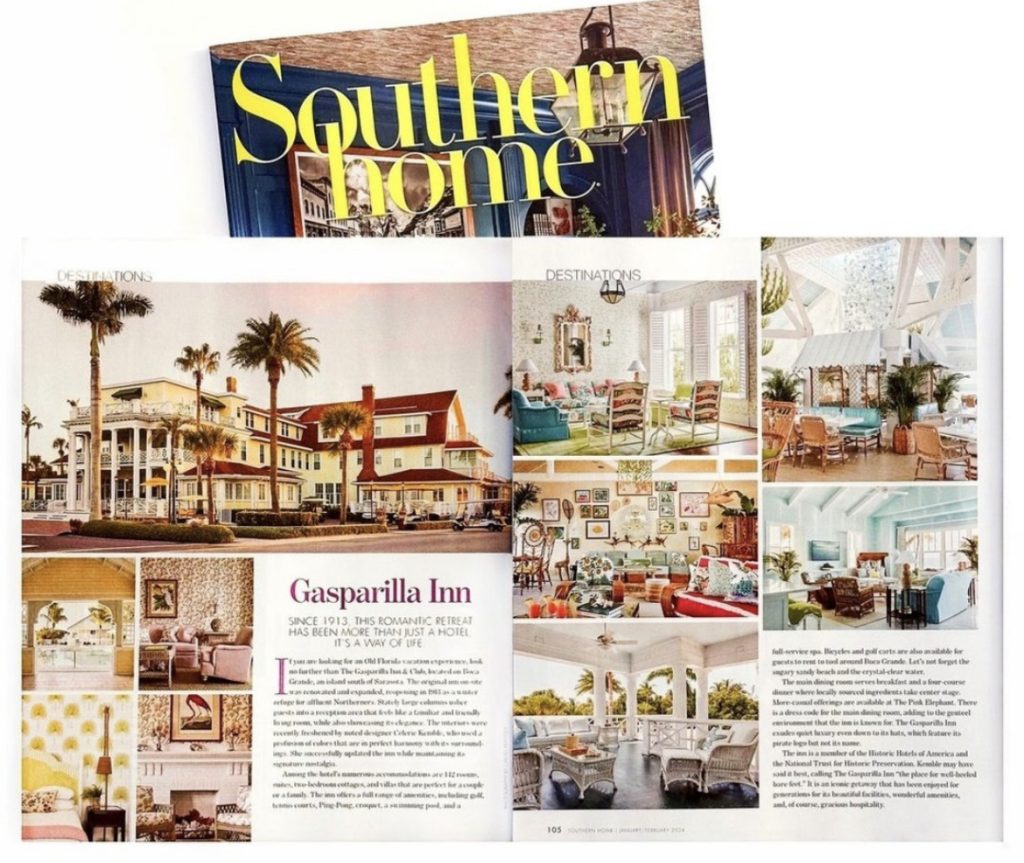
The Gasparilla Inn

Step into a sun-drenched time capsule of Old Florida glamour

To step into a sun-drenched time capsule of Old Florida glamour, where meticulously maintained, century-old structures and traditions meet an exuberant mix of coastal maximalism and island whimsy. The Gasparilla Inn is more than just lodging; it’s a living legacy of hospitality that has remained perfect through the decades.

Read more at Conde Nast Traveler

Friends of Boca Grande Release 2025-2026 Happenings

Founded in 1986, Friends of Boca Grande is a non-profit organization with a mission to present outstanding cultural and educational programs for Boca Grande.

From world-class concert and jazz series to dynamic lectures, workshops, and community celebrations, we provide one-of-a-kind programming that fosters engagement and brings people together. See the best of the season in the annual Happenings Guide.

Read Happenings Here

Luxury Lens: What premium can homes close to top U.S. schools command?

What premium can homes close to top U.S. schools command? Quite a substantial one, it turns out—no less than 135%, when measured nationwide.

A recent study by Realtor.com®, “Where Families Are Heading: Most Popular School Districts This Moving Season,” published in August 2025, compared median listing prices in the most popular U.S. school districts with those in their wider metro areas.

It found that from May to July 2025, homes in these districts—and near schools rated highly by the widely used school search website GreatSchools—attracted a 135% price premium, with a median home price of US$1.21M compared with nearly US$515k for homes out-of-district but in the same wider metro area.

Even where GreatSchools ratings were mixed, simply being located in what buyers perceived as desirable school districts added a 29% premium. And for buyers purchasing in the country’s most sought-after school districts, the premiums were far higher.

Topping the list with the highest percentage premium of 390.9% and a US$2.2M median home price was a district in Dallas, Texas. Meanwhile, the priciest school district in the U.S. was in Laguna Beach, California, where buyers faced a 322% premium and nearly US$5M median home price. It should be noted that this impact on value is material to buyers and sellers irrespective of whether they actually intend to make use of the applicable schools themselves.